Back to the Future of Engineering
AI may be reviving an old sequence: performance first, explanation later.
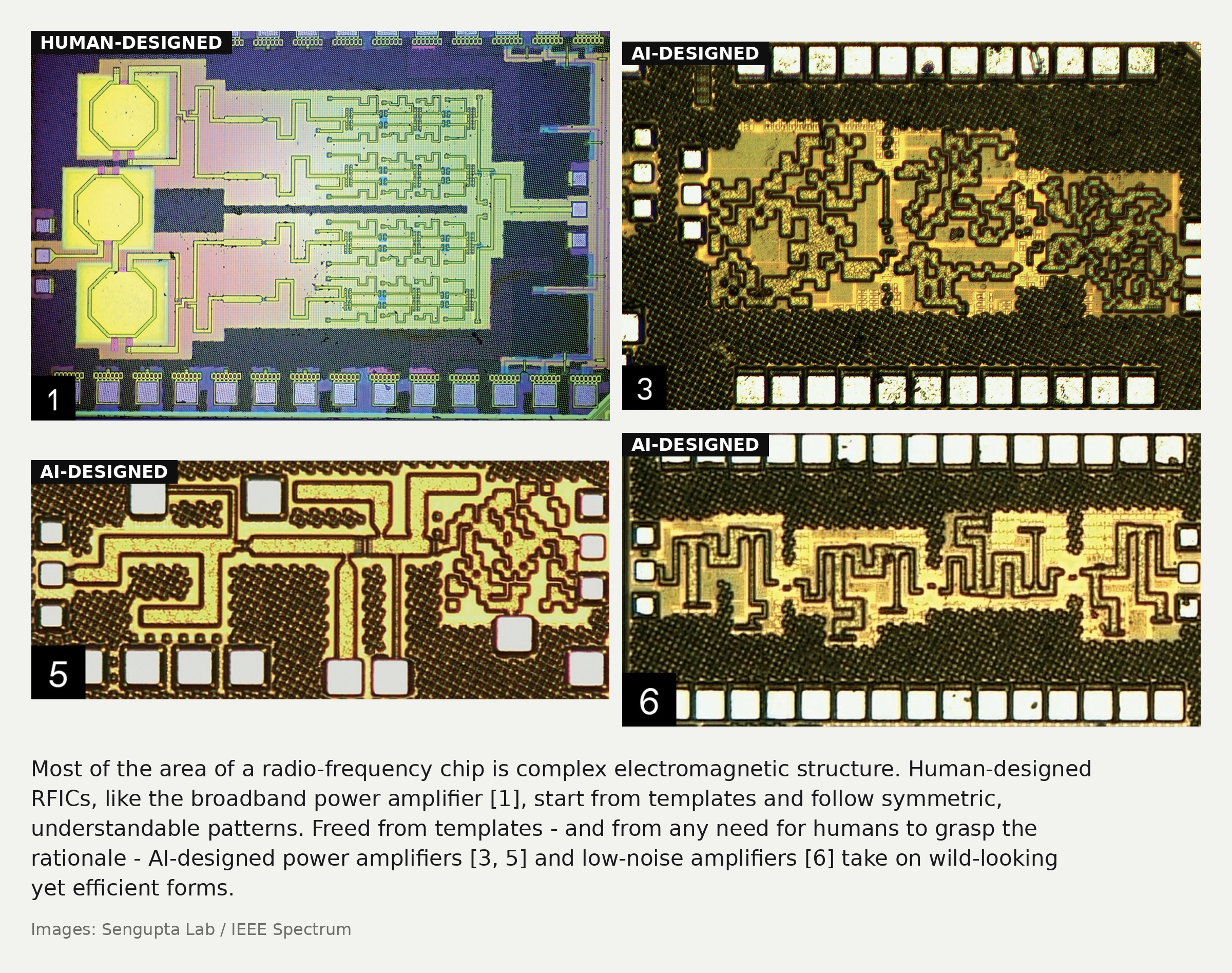
In December 2024, researchers at Princeton demonstrated a new way to design radio-frequency circuits. Instead of selecting a familiar topology and adjusting a handful of parameters, the engineer specifies the desired electromagnetic behaviour and a machine searches arbitrary pixelated geometries. A 25-by-25 grid contains an astronomical number of possible designs. Once trained, the system can produce candidates in minutes; the researchers fabricated and measured several of them.
The resulting shapes look less like conventional circuits than jagged patches of metal. Yet they work.
This is not a breakdown of physics. Maxwell’s equations still govern every field and current. The designs can be simulated, manufactured and tested. What may be missing is something narrower but important: a compact, human-usable account of why this particular shape is the right one.
That sounds unprecedented. Historically, it is almost familiar.
The artefact knew more than its maker
Before engineering became heavily mathematical, builders relied on apprenticeship, precedent, rules of thumb and forms refined through repeated success and failure. A shipwright could know how to build a seaworthy hull without possessing fluid dynamics. Technical knowledge was often embodied in practices and artefacts rather than compressed into general principles.
The artefact could contain more knowledge than its maker could articulate.
Modern engineering did not simply replace craft with science. It connected two kinds of knowledge: knowledge of what works and knowledge of why. The historian Joel Mokyr calls these prescriptive and propositional knowledge. Modern technological progress accelerated when practical techniques and formal explanations began feeding each other more systematically.
Often, practice came first. Steam engines were operating before thermodynamics became a mature theory; the effort to understand and improve them helped generate the science. But once articulated, theory did far more than rationalise what craftsmen had already found. It made knowledge portable, criticisable and extensible. It allowed engineers to reason beyond inherited designs and build things no tradition had tested.
For two centuries, the balance shifted towards explanation - not because equations replaced experiment and experience, but because causal models could carry confidence into situations where experience ran out.
AI-driven design may shift the balance again.
Not craft - a spiral
The premodern craftsperson inherited a form whose logic was partly tacit. The AI engineer begins with explicit aims and constraints, then receives a form discovered through search. One comes from tradition; the other from optimisation. Both may work before anyone can give a satisfying human-scale explanation of the resulting geometry.
But this is not a return to craft. It is a spiral.
The old sequence was: build, survive, copy.
The new sequence may be: specify, search, assure.
When generating candidate designs becomes cheap, defining the problem becomes more important. The engineer must state the required outcomes, prohibited failures, materials, manufacturing limits and operating domain. But no specification can ever be definitive or perfectly exhaustive. Reality contains combinations, degradation mechanisms and misuses nobody anticipated.
The future discipline is therefore not simply specification. It is assurance under incomplete specification.
That means making a bounded claim about what a design can safely do, then supporting it with a comprehensible body of evidence: physical theory where available; simulation; manufacturing controls; destructive and adversarial testing; repeated builds; uncertainty analysis; and monitored performance in service. Safety-critical engineering already uses assurance cases of this kind: structured arguments connecting claims about a system to evidence within a defined environment.
The design may resist a neat narrative. The safety case cannot.
The burden moves
Autonomous driving already exposes this logic. A vehicle cannot be justified by writing down every rule its learned systems use. Yet field mileage alone is also inadequate. Because serious crashes are rare, RAND estimated that proving safety statistically could require hundreds of millions or even billions of miles. The answer is a combined case: an explicit operating domain, engineered constraints, simulation, critical scenarios and field evidence - not explanation or statistics alone.
This is the necessary correction to the seductive “back to craft” story. AI does not make causal understanding obsolete. Explanation remains uniquely powerful because it supports extrapolation: it tells us why performance should persist outside the cases already observed. Where failure is rare, delayed or catastrophic, empirical evidence without a causal account may never carry enough weight.
Nor is the Princeton circuit literally incomprehensible. It is governed by known physics and was generated through models built using physical insight. The novelty is that its successful form may not compress into the modular design language through which engineers ordinarily communicate intent, diagnose failure and generalise from one artefact to another.
Computational opacity itself is not new. Philosophers have long noted that sufficiently complex simulations contain more epistemically relevant steps than any human can inspect. Trust in them is instead built through verification, validation, robustness, successful use and expert control.
AI is therefore not changing engineering from knowledge into ignorance. It is changing the allocation of the epistemic burden.
Engineering has always combined theory, trial and accumulated performance. Machine search may now produce forms for which explanation carries less of the initial burden and assurance carries more. Human responsibility does not disappear. It moves upstream into the objectives and downstream into the proof.
The Princeton circuit is a small object, but it opens a large question. For much of history, engineers discovered what worked before they could explain why. Scientific engineering tightened the feedback loop between practice and theory until explanation became one of its greatest powers. AI may restart that cycle at machine speed: discovery first, explanation later - where a useful explanation can be found at all.
The future of engineering may resemble its past, but with one decisive difference.
Our ancestors inherited opaque designs and trusted their survival.
We may deliberately generate them - and will have to make the reasons for trusting them explicit.
Elliot Ronald is founding partner of Lion Strategy, which advises boards and investors on AI strategy and governance.
[1] Karahan, E. A., Liu, Z., Gupta, A., Shao, Z., Zhou, J., Khankhoje, U. and Sengupta, K., “Deep-learning enabled generalized inverse design of multi-port radio-frequency and sub-terahertz passives and integrated circuits”, Nature Communications, Vol. 15, 10734, 30 December 2024 - the Princeton demonstration: desired electromagnetic behaviour specified, arbitrary pixelated geometries searched, candidates produced in minutes, several fabricated and measured.
[2] Sengupta, K., “AI Learns the ‘Dark Art’ of RFIC Design”, IEEE Spectrum, June 2026 - first-person account by the lead researcher, and the source of the chip micrographs above (Sengupta Lab / IEEE Spectrum): one AI-designed amplifier “looked more like an arbitrary pattern or perhaps a QR code”.
[3] Mokyr, J., The Gifts of Athena: Historical Origins of the Knowledge Economy, Princeton University Press, 2002 - propositional (“why”) versus prescriptive (“what works”) knowledge, and their systematic feedback as the engine of modern technological growth.
[4] Kalra, N. and Paddock, S. M., Driving to Safety: How Many Miles of Driving Would It Take to Demonstrate Autonomous Vehicle Reliability?, RAND Corporation, RR-1478, 2016 - demonstrating rare-event reliability statistically could require hundreds of millions, and sometimes billions, of miles.
[5] Assurance cases - structured claim–argument–evidence practice in safety-critical engineering: the Goal Structuring Notation (GSN) community standard; UL 4600, Standard for Safety for the Evaluation of Autonomous Products.
[6] Humphreys, P., Extending Ourselves: Computational Science, Empiricism, and Scientific Method, Oxford University Press, 2004 - epistemic opacity: sufficiently complex computational processes contain more epistemically relevant steps than any human can inspect; trust rests on verification, validation and use.